Mothers of the Homeland
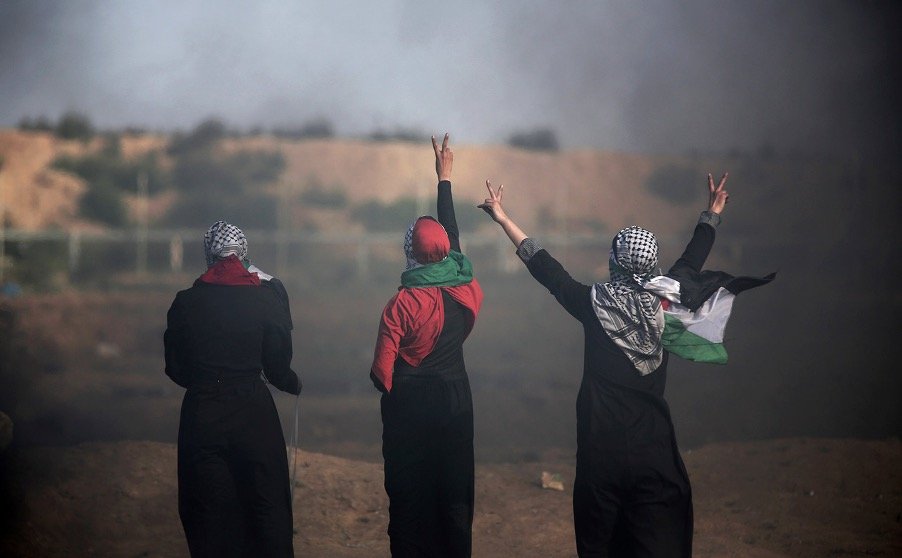
In the picture, we can see three women holding the Palestinian flag and the Keffiyeh, a traditional scarf that signifies Palestinian nationalism and resistance against occupation. They are holding up peace signs and confidently walking into a smoke-filled scene. I call them “mothers of the homeland” not to confine a women’s role to motherhood, but to evoke the fierceness with which they have defended their country, as they would a child. This phrase speaks to their commitment, not to a role they must play. I have chosen this image for my essay as it captures the resilience and motivation of the women in Palestine. It also challenges the sexist attitudes towards women in wartime and the performative feminism displayed by Israel and the West. This image cannot tell us everything about these women, or stand for all Palestinian women. The gap between what we see and what we assume is where this blog begins.
Beyond the image of the victim
Palestinian women have often been painted as passive victims of war, while their presence in political resistance has been erased. They have been reduced to helpless brown women in need of a white man’s rescue from the brown man (Abu-Lughod , 2002:784). This is not to say that women are not victims of war, for they pay the highest price for the brutality of the oppressors. It is important to note that their suffering cannot be ignored one moment and used the next to justify violence carried out in their name. The world cannot photograph their blood and tears and claim to cut them free with the very blade they hold against them.
Women were the first victims of the Israeli occupation, they were subject to systems of colonialism and patriarchy (Louise, 2021). Mariam Afifi discusses the gender-based dimensions of the occupation (Louise, 2021). UNHCR reports found that inadequate medical care during pregnancy was the third cause of mortality among Palestinian women of reproductive age. Israeli settlers frequently attack girls going to school, and families have become too afraid to send them. City council banners told Israeli soldiers to “pound their mothers and come home to your own mothers” (Decolonize Palestine). These examples show how women’s health, education and safety become sites of political violence. Sexual violence is used to terrorise and silence women, turning their bodies into another site of conflict. Women are afforded the status of being “naive objects of protection, pacification, and humanitarian salvage” (Khalil, 2011:1479). But the problem lies in seeing women only as victims in need of protection, this makes their suffering visible while their resistance and real needs are pushed out of the frame.
Women in resistance
The cameras pan to show women beaten and bloodied. They strategically turn them away before these women can speak or act beyond the image of a victim. Yet, since the creation of the Israeli state in 1948, women have “mobilised alongside men in the struggle for their right to self-determination” (Louise, 2021). The first Intifada saw more than 3,000 women in Israeli prisons for their activism. Women formed committees and defied curfews to bring food and medicine to besieged neighbourhoods. Some wore Islamic dress as a sign of resistance and respect for the martyrs of the resistance (Louise, 2021). Others defended places of worship, among them the Murabitat, who protected the Al-Aqsa mosque and became symbols of resistance. Israeli police arrested some of these women, branded them extremists and buried their names. But their actions did not disappear, social media gave activists another way to tell their own stories. Women were at the forefront of the movement against the expulsion of families in Sheikh Jarrah. Mariam Afifi was a notable figure in these protests. She was beaten and intimidated by police, and an image of her smiling while being arrested was globally circulated. Afifi warned, “If we women do not resist this occupation, if we do not claim our rights, if we do not fight to stay on this land, who will?” (Louise, 2021).
Women have chosen to resist against occupation in multiple different ways. The actions and the beliefs they hold are not identical. Each woman deserves the right to decide whether to resist, what form this resistance takes and what this means to her. Choice has long been restricted by rules about where women belong, what they should wear and who may speak for them. Palestinian women face all these rules alongside the occupation. So when Israel argues that the women resisting are exploited by men (Khalil, 2011:1476), to explain away women’s involvement in resistance. They are denying them the autonomy of their own decisions and the motives that drive their actions. The assumption is repeated that women cannot think or act for themselves. They sweep their resistance under the rug of Islamic extremism, and the West blindly follow suit. They are oblivious that by accepting Israel’s explanation that female resistance is a result of male coercion, they are mirroring the misogyny they so loathe. They are denying Palestinian women the agency and rationality to resist the occupation on their own terms.
The politics of saving women
This brings me to the gap between speaking about women’s rights and actually protecting them. In an attempt to make Zionism modern and socially acceptable, they sell the idea of Israel being “a liberal haven” (Decolonize Palestine). Palestinian men are painted as aggressive, violent extremists who oppress and violate women. In doing so, they imply that women would be “better off” under Israeli rule (Decolonize Palestine). By casting Palestinian men as a threat to women, they present themselves as protectors, while drawing attention from the violence against Palestinian women by Israeli forces. The UN’s report on Israel’s systematic use of reproductive and other forms of gender-based violence since 7 October 2023 was extremely revealing. They found a large increase in sexual and gender-based crimes that were intended as a form of collective punishment for Hamas’ actions on the 7th of October. The idea that Israel represents “salvation from this misogyny” must be challenged. With their colonial, apartheid structure, Israel is the farthest from a haven for Palestinian women. And sexism within Palestinian society does not make occupation justifiable.
Women are infantilised by claiming that their involvement in the resistance is coerced by Palestinian men. Then, they punish women for the resistance by raping and abusing them, while maintaining their position as self-proclaimed feminists and protectors of women. This is the textbook definition of purple-washing: “a state or organisation's appeal to women’s rights and feminism in order to deflect attention from its harmful practices” (Decolonize Palestine). Moreover, the UN (2025) report found that “Israeli military operations in Gaza have had a disproportionate impact on Palestinian women and girls, who continue to bear the brunt and pay the price for decisions made by those in power while themselves marginalised from decision-making and military and political power”. What happened to the safe haven?
Abu-Lughod (2002:787) discusses how she received email petitions defending Afghan women under the Taliban, but “had never received a petition from such women defending the right of Palestinian women to safety”. This demonstrates that this was never about women’s rights or saving them from the ever-so-oppressive hands of Palestinian men. Palestinian men only became a problem once the genocide became a part of the news cycle. People were quick to halt support for the Palestinian cause, claiming their alleged sexism and homophobia made them unworthy of basic human rights. This was never about women’s rights, this was about shutting down criticism of Israel and justifying bombings and interventions (Abu-Lughod, 2002:784).
Some wonder how Israel can escape accountability for their hypocrisy. Abu-Lughod discusses how this is done through the framing of the issue. Rather than exploring the history of Palestine and the facts of the genocide, experts are asked to give religio-cultural explanations (Abu-Lughod, 2002:784). In this case, the Israelis present Palestinians as culturally backward, woman-beaters who must be confronted. By framing the issue through that narrative, Israel can divert the media and the world’s attention away from their genocidal actions and towards a manufactured debate that blames Palestinians.
Listen without speaking for
The West are quick to cry oppression, misogyny and assault on human rights. Some seem more concerned for a cloth covering a woman’s hair and less for the bombs and bullets that cover her streets. But neither an outsider who calls her clothing proof of oppression nor one who declares it proof of resistance can decide what it means for her.
The arguments I have discussed mirror the clash between colonial feminists and intersectional feminists. The colonial feminists wear their tinted glasses, seeing a woman to rescue. They neglect the violence committed against Palestinian women under occupation and point their fingers at Palestinian men. Intersectional feminists, on the other hand, understand that no two women’s lives and hardships are the same. We cannot apply the feminism we have in the U.K. to a rural village in Nablus and pretend that women in these places face identical choices. Intersectionality would question how occupation shapes choices and would confront the sexism within Palestinian society without using it to justify Israeli rule. Above all, it would listen to Palestinian women and their needs rather than deciding what freedom should look like to them.
I end this by asking you to look at the women in the photograph again. They are more than evidence of suffering, and more than symbols of resistance. They are people whose lives cannot be contained by an image. We cannot let claims to save them drown out their voices. We must listen to the mothers of the homeland.
Alas, for Israel, human rights are merely a suggestion.
Abu-Lughod, Lila (2002) “Do Muslim Women Really Need Saving? Anthropological Reflections on Cultural Relativism and Its Others”, American Anthropologist 104(3)783-790
Decolonize Palestine (n.d.) “Purplewashing, Decolonize Palestine, n.d., accessed at https://decolonizepalestine.com/rainbow-washing/purplewashing/, 21 Jul 2026
Khalil, Laleh (2011) “Gendered practices of counterinsurgency”, Review of International Studies 37 1471-1491
Louise, Emilia (2021) “Palestinian Women on the Front Line against Israel’s Occupation”, Left Voice, May 27, accessed at https://www.leftvoice.org/palestinian-women-on-the-front-line-against-israels-occupation/, 21 Jul 2026
Staff, Toi (2023) “Israel accuses Hamas of using over 100 women and children as human shields in Gaza”, The Times of Israel, 2 Nov, accessed at https://www.timesofisrael.com/israel-accuses-hamas-of-using-over-100-women-and-children-as-human-shields-in-gaza/, 21 Jul 2026
United Nations, (2025) “Report of the Commission of Inquiry: Israel’s systematic use of sexual, reproductive and other forms of gender-based violence since 7 October 2023”, United Nations, 13 March, accessed at https://www.un.org/unispal/document/report-of-the-commission-of-inquiry-israel-gender-based-violence-13march2025/?utm_source=chatgpt.com, 21 Jul 2026
