At protests, my mother told me to cover my face. But I wanted them to see me. I am a human, look at me. I am not a number or a statistic, an immigrant, a headline. Look at what your silence has done.
About me
I inherited stories of war and loss before I inherited any clear sense of home. My mother’s side begins in Gaza, where my grandfather was forced to leave and in Lebanon, where my grandmother still dreams of the Beirut streets she, too, once fled. My father’s side traces back to Jerusalem, to a home a stone’s throw from Al‑Aqsa, and to a family that watched their city and their future be taken from under them. My grandmother on that side also carries a history of escape; she fled Bosnia and not even her name remained unchanged.
My parents spent their childhoods fleeing wars, expelled from Kuwait and forced to start over and over again. I was born in Jordan and moved to the UK when I was five, carrying all of that privilege and history without the words for it. I grew up in predominantly white areas where people asked if Jordan was a state in America and had no idea what Palestine was. I remember pointing it out on the map, and they would ask, “Israel?” I swore I would never call it that.
Now I study International Relations at Queen Mary University of London, trying to make sense of the violence my family lived through and to write it back into the record. Ironically, the very university that teaches me about peace, democracy and human rights invests tens of millions in companies that arm Israel. I have grown used to this kind of distance, where violence is dissected in classrooms, then left behind when the lecture ends. I grew up with Al Jazeera in the background; I never had the luxury of leaving it all behind. Palestine. Syria. Lebanon. Kuwait. Yemen. Egypt. Iran. Iraq. Afghanistan. Libya. The list goes on. For that, I am strangely grateful. I would rather be haunted by their faces than live a life untouched by their reality.
Apart from writing, I love to travel, play the violin and cook for my friends and family. It does sting knowing that I could have easily been born under apartheid and only dreamed of such joys in life.
About my visit to the Homeland
December 2021. We refused to fly to Ben Gurion Airport, to be questioned by their officers and surrounded by their people. Instead, we took a coach and crossed via the King Hussein Bridge. The tour guide told us to close the blinds so we would not get sniped. Tourists. In a coach. Sniped. When we reached the crossing, there was an air of unease, they wanted bribes. They had us queued up like animals, women, children, and the elderly, all crowded together like cattle.
The officer asked me who my grandfather was, who my great‑grandfather was, and their fathers after them. He was not happy that I did not know (if the land is not ours, why does my lineage trouble him?). They interrogated us like criminals, as if it were a crime to come to our land. He told us we should be grateful he let us through, that we should go tell our friends and families that the Israelis are good people. As if he owed us for allowing us into our own home. And if they are such good people, why did they square their chests and point their guns?
We went to visit one of my family’s remaining homes. They had carved it in half: one side for us, the other turned into a military base. Our neighbours told us stories of soldiers and settlers who would attack them, trying to scare them out. When that did not work, they began throwing guns and drugs into our yard, hoping to have them arrested and take what was left of the house. As if they had not taken enough.
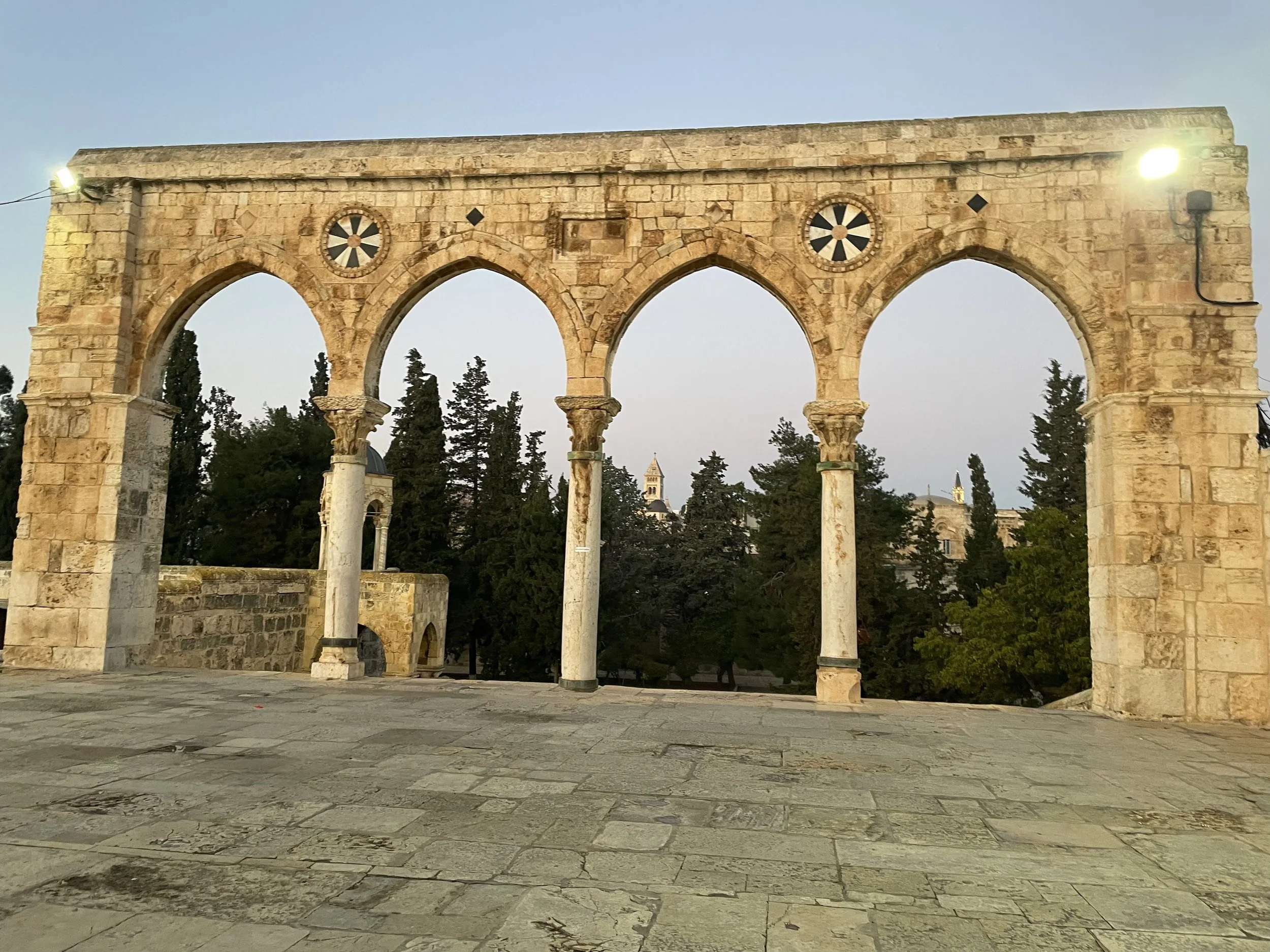
When we visited Masjid Al‑Aqsa and the Dome of the Rock, they would close each gate, trapping us inside, deciding who to let out and when. They stopped people from entering the mosque for prayer, just because they could. It is through this constant psychological warfare that they have turned Palestine into an open prison for those who remain. My story is not unique; it is not even traumatic. But it shows how, even as we clutched our bright, blue, British passports and walked the streets in our Western clothes, they did not care. In their eyes, we were Palestinian and we deserved this.